Tuesday, September 9, 2014

What does your desk say about you?

This post corresponds to day #8 of the +TeachThought 30-day blogging challenge, focused on reflective teaching through blogging.  Interested in joining the challenge?  It's not too late! 

Here's a thought-provoking question: What does what you have in/on your desk say about you?

Well, here's a peak at my desk--


Top of my desk: I just got rid of my desktop, so have a lot more space now! Perfect for the collection of stuff that tends to accumulate there - a laptop charger, QR codes, past issues of Tech & Learning, and of course, my coffee mug!  Truth be told, when I'm in my office, I usually sit at a table instead of at my desk - it makes it easier to collaborate and spread stuff out.  I decided to give my desktop up because I found that I was using my iPad and laptop way more than my desktop (it started collecting dust).  I like to be mobile and able to work wherever I am, and a desktop just doesn't fit that work style.

Inside my desk drawers, I have tech supplies and devices - stuff that I pull out when needed - card readers, iPad keyboard, digital camera. My other tech devices (my iPad, phone, and my laptop) are often with me wherever I am. My other drawer has a few paper files - most of which I've taken a picture of and uploaded to my Evernote or Google Drive, depending on if they're notes (Evernote) or resources for students/staff (Drive).  I think the contents of these drawers also show that I like to be mobile, and that the devices I use everyday are pretty good at doing what I need them to do.

When I thought about it, maybe what's not on/in my desk says more about me than what's there.  No desktop, few paper files, etc.

So.... what does your desk say about you?

Monday, September 8, 2014

On Mentors and Inspiration

This post corresponds to days #6 & 7 of the +TeachThought 30-day blogging challenge, focused on reflective teaching through blogging.  Interested in joining the challenge?  It's not too late! 


Mentors are awesome people.

They help, support, and guide you when you need it.  They share connections, ideas, and experiences.  They challenge you to think about things differently than you have before.   They give you space to discover things on your own.  They join you in celebrating successes and reflecting on failures. They believe in what you can do!

Five years ago when I first started at my school, I was a pretty new teacher and had lots of ideas I wanted to try out - many of them involving technology, as I had just taken a Master's course on using technology with English learners.  I was excited to find out that I was issued a staff laptop, and was thrilled that one of my first staff development experiences at my new school was a hands-on session about the value of Twitter for educators.  Through conversation, support, and inspiration from the school's technology integration specialist, +Laurie Toll, I began to explore new uses for technology with my students: blogs, Google Docs, learning management systems, wikis, podcasting, etc... Laurie was an awesome mentor (and still is!) because she listened to my ideas, offered a few of her own, helped me access the tools and resources I needed, and supported me as I put my ideas into practice.  Then, we'd have great discussions about how things went and what the next steps could be.  My passion and excitement for educational technology grew in my three years as an ESL teacher at my school, and I am so appreciative of the guidance and support that Laurie, along with several other teachers, provided me along the way.  I seek to be a mentor and support for others as well, as I know what a difference it can make!


As teachers, it's humbling and inspiring to think about the impact we have on our students.  Interestingly enough, I don't think we often pause to think about the equally inspiring impact we can have on our colleagues!  When I think about the amazing people I work with every day, and the educators I connect with through my PLN, I know I am a better teacher because of the things I've learned (and continue to learn) from them.   

Another blogger, +Tracey Kracht, wrote about a great idea for recognizing people who inspire her and make her think - in her latest blog post, she said that she is going to start using Twitter's #ff or #FridayFollow as a way to identify those who inspire her.  I love the idea and I'm going to do that, too!  This school year, I'm going to use #ff to recognize people who inspire me and help push me forward with their ideas, actions, and impact.   Interested in doing the same?  Join in this Friday - share the Twitter names of a few educators who inspire you, along with the hashtag #ff, and we'll follow, share, and learn together! 

http://thenounproject.com/term/big-idea/13678/


#ff

Saturday, September 6, 2014

My Teaching Space


This post corresponds to day # 5 of the +TeachThought 30-day blogging challenge, focused on reflective teaching through blogging.  Interested in joining the challenge?  It's not too late! 

As a technology integration specialist at a STEM elementary school, my teaching space is flexible, and it goes wherever I go.  I love to collaborate, and I spend pretty much all of my days in other teachers' classrooms.  But I also love to embrace teachable moments (I love being a learner through them as well), and so am completely comfortable with the idea that any place could become a teaching/learning space. 

Here are two photos that represent my teaching space.  The top one shows our school's engineering lab, which is a shared space where I facilitate many lessons when not in teachers' classrooms.  The bottom photo shows one of our school courtyards.  This photo represents the flexibility of my teaching space - I'm often on location with students as they're learning to help guide and support their use of technology to document, research, share, or collaborate around their growing understanding of a concept.


If I could write a wish list of things I'd like to include in my teaching space, I think my top (philosophical) request would be inquisitive students who are willing to be risk takers in their learning. Speaking more tangibly, I'd also love an Apple TV or Chromecast for the engineering lab, along with some posters about inquiry, the importance of failure in learning, and our school's maker manifesto (currently a work in progress).  I'd also love to have another monitor in the e-lab to showcase students' digital work and maybe even to facilitate collaborative conversations within small groups of students (to display screens, etc), or with outside experts (G Hangouts), or even other students around the world. While I'm at it, I'd also like all students to have access to an iPad or Chromebook whenever they need one or the other...


How about you? What's on your wish list for your classroom or teaching space?


Thursday, September 4, 2014

A Few Things I Love About Teaching

This post corresponds to day # 4 of the +TeachThought 30-day blogging challenge, focused on reflective teaching through blogging.  Interested in joining the challenge?  It's not too late! 


Some people always knew they wanted to be a teacher...but that really wasn't me...

image:  http://thenounproject.com/term/school/10119/

You see, my mom was a teacher and is now a school counselor, and my dad is in IT, and I distinctly remember telling them both at some point in my childhood, "I never want to do what you do for a living".  I was convinced I wanted to find my own way and explore my own options.

After majoring in global studies and Spanish, I worked in the business world for a few years.  But, it just wasn't very fulfilling for me...so, I began volunteering with kids in my spare time, and before long, I realized that I was happiest when I was with the kids.  So, I decided to go back to school to get my teaching license and got a job as a paraprofessional in a school.  Once I completed my teaching license, I got a job as an ELL teacher.  This is now my sixth year of teaching, and my second year as a technology integration specialist at a STEM elementary school, and I love what I do!

Looking back, it's pretty funny to think that I told my parents that I never wanted to be a teacher or work in IT, since now I do a job that integrates both fields...I guess the joke's on me!

image: http://thenounproject.com/term/heart/219/


So, what do I love the most about teaching?

Three things...


  • I love the energy, enthusiasm, curiosity, and passion that form an inextricable part of teaching and learning.  They're contagious, and they pass back and forth between teachers and students as new learning occurs and interests are ignited.  
  • I'm a lifelong learner myself, and I love to be surrounded by and a part of continuous learning.
  • Most of all, I love to step back and see what kids can create when given the chance. I'm constantly amazed, inspired, and energized by all of the awesome things kids can do.  
    • For example, today a student of mine showed me that he created an ALS Ice Bucket Challenge animation on Scratch. It was awesome.


What do you love the most about teaching?


Wednesday, September 3, 2014

Reflective Teaching through Blogging

What better way to jump start the school year than participating in TeachThought's Reflective Teaching: 30-day blogging challenge for teachers?  The +TeachThought challenge is focused around reflection and connecting with other educators through blogging, and prompts are provided for each day.

The challenge encourages teachers to blog everyday in September, but since I'm just jumping in now I'll reflect on the first three prompts in today's post.

1.  My Goals for the School Year

This summer, a colleague asked me about my goals for the 2014-15 school year, and although I didn't have a very polished answer at the time, her question provoked some good conversation, and I've narrowed my goals for this year down to the following three:

  • I will encourage, support, and integrate app-smashing while working with my staff and students.  
    • Reasoning: app-smashing allows for student choice in how they show what they know.  It also gives students a chance to show their creativity, and to think outside the box.  
  • I will continue to integrate coding and computer science education into my work with students, and into projects and lessons in various grade levels and content areas.
    • Reasoning: after spending the summer teaching coding to kids, and doing a fair amount of coding myself, I'm even more convinced of its value for students.  The skills developed through learning to code, such as collaboration, persistence, and problem-solving, apply across subject areas and grade levels.
  • I will model the maker mentality for my students by being a maker myself; sharing my failures, successes, and milestones of learning, and by celebrating the process over the product.
    • Reasoning: our school was awarded a grant to create a makerspace this year.  Our makerspace will be an undefined makerspace, as it's not confined to a physical space in our school.  Instead, we can bring it to any place through the materials we use or simply through our mentalities and the language we use with students.  I think that's powerful... and, I just really love making things (this week, I wore a shirt and a skirt that I made, and I can't wait to make more!)...  
2.  New Technology for this Year

This year, I am excited to try out Chromebooks with students.  I was recently awarded a grant to purchase Chromebooks to use for coding with 6th graders, and I can't wait to get started!  Chromebooks are so cost-effective, powerful, and easy-to-use... I think they will be popular with students and staff alike.  I bought myself a Chromebook this summer (an Acer c720p), and I absolutely love it.  I rarely use anything else!  A big bonus from an integration standpoint is that Chromebooks are compatible with Flash, which is perfect for coding on Scratch, and I've heard that they can also connect to Arduino and Makey Makey kits.  I also love that they run (virtually) everything through the cloud - no need to download, print, or save to a shared drive.  I'm still deciding which Chromebook model to purchase for school.  I'll be sure to post updates as the year unfolds.

3.  An Observable Area to Improve Upon

I recently went through the first round of ENVoY training, and I'm excited about the power of non-verbals in teaching and learning.  I've already enjoyed trying out some of the non-verbal classroom management strategies, such as above pause whisper, which is a technique to bring a group back together.  I tried it with students and also with staff, and was impressed by how well it worked.   The clearer and more intentional I am about my non-verbal messages to my audience, the clearer and easier to understand my message will be to them (hopefully). 

I'm looking forward to blogging about reflective teaching this month!  I'd love to connect and hear about your thoughts and experiences.  Feel free to leave a comment below, or connect with me on twitter @wilsandrea.  

Friday, August 8, 2014

Screencasting and English Learners

I just want to put this out there:  I [finally] finished my masters!!  I graduated in May, after turning in my 120-page Masters' thesis (that'll leave a mark).

Here's how I looked after my graduation ceremony:

My masters is an M.A. in English as a Second Language, and my thesis was a case study of 6 3rd grade English learners.  In my research, I was interested in finding out if screencasting seemed to help develop the fluency and complexity of English learners' math language.  As it turned out, it did (especially for those students with developing levels of English proficiency)!

Check out these slides for a quick summary of my research and findings:


So what does this mean for the classroom?
  1. Offer screencasting, and the instructional scaffolds that support it, as an option in students' learning opportunities
  2. Provide a structure for academic language development and an authentic context for all students to practice it
  3. Include opportunities in your students' learning for self-assessment and reflection, as both are important to the development of language and content knowledge
  4. Engage students in peer-teaching opportunities - they're low-risk experiences for learners, provide authentic audiences for content and language practice, and they give students a chance to reflect on their understanding of the content.  


Thursday, August 7, 2014

Inspiring Girls to Code [for Good]

"Now that I've started programming, I never want to stop!" --Quote from one of the 6th grade girls I mentored as a part of the Technovation Challenge

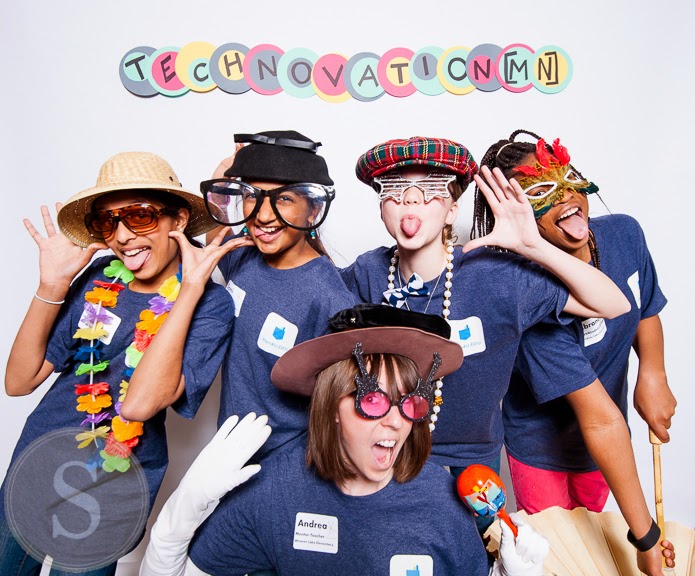
I mentioned in a previous post that I mentored a team of 6th grade girls this year as a part of the global Technovation Challenge.  It was an awesome experience, both for me as a coach/mentor, as well as for the girls who participated, because it gave them an opportunity to create and program an app that helped address an issue or problem in their community.  My team, the #WVRCodeGirls, created a homework planner app, called Plan4U.EDU, to help middle schoolers stay more organized.  They were programming with a purpose in mind.  I liked to tell them they were coding for good.

At the end of the Technovation Challenge, many teams in MN celebrated by attending an event called Appapalooza.  Appapalooza gave all of the MN Technovtation teams a chance to pitch their apps, show a demo of their app, and describe the issue it addressed.  It was so powerful to see and hear from the teams of teenage girls about the issues they feel are important, and the apps they created to help their peers and the community address and prevent these issues.

I'm definitely planning to mentor/coach another Technovation team next year.  Interested?  Check out TechnovationMN's website for more info: http://technovationmn.org/

Our team at Appapalooza - photo: Satori Photography


Another excellent opportunity to inspire girls in programming is KatieCoderDojo, free 2-hour coding sessions for girls in Scratch and App Inventor at St. Catherine University.  It's so inspiring to see what the girls create!  And, no previous coding experience is necessary, so it provides a great intro to coding for girls.  I really enjoy being a part of the mentor team for these events!

The next KatieCoderDojo is August 12th at St. Catherine University - interested in signing up a girl you know?  Here's the link to the Eventbrite.


So, how do we get more girls interested in coding?
Here are my thoughts...
  • give girls opportunities to try out coding
  • give them a purpose for coding
  • connect them with other female coders; mentors and peers
  • encourage them to stick with it
  • give them resources to explore and let them know of opportunities, like TechnovationMN, KatieCoderDojo, and Google's Made with Code

My colleague, +Karla Juetten recently sent me an article entitled, How not to attract women to coding: Make tech pink by Kristen V. Brown.  It makes some great points about the gender gap in computer science, and why 'making tech pink' is not a successful way to get more females interested.

So, girls, be confident, dare to dream, and let's get coding...for good!